
A parasite problem in a professional boarding facility rarely begins with an obvious outbreak. It may start with a dog that scratches slightly more than usual, a small amount of abnormal stool, or a tick hidden beneath thick fur. By the time the problem becomes noticeable, other dogs may already have encountered the same parasite through shared sleeping areas, contaminated surfaces, outdoor exercise spaces, or direct contact.
This is one of the more complicated responsibilities in professional Dog Boarding. Unlike a private household, where the number of animals and their movements are relatively limited, a boarding facility regularly receives dogs with different medical histories, preventive-care routines, and exposure backgrounds. Some arrive after receiving consistent veterinary parasite prevention. Others may have missed treatments, recently visited contaminated outdoor environments, or developed an infestation that their owners have not recognized.
The challenge is not simply to identify parasites and administer medication. Effective control requires an understanding of parasite biology, transmission routes, environmental survival, diagnostic limitations, and the possibility of reinfection. A treatment that eliminates adult fleas, for example, does not necessarily remove immature flea stages from the environment. Similarly, treating an intestinal infection without addressing contaminated surroundings may allow exposure to continue.
A reliable Dog Boarding parasite-prevention program must therefore combine individual animal screening, veterinary coordination, environmental management, staff education, and continuous monitoring. Each component addresses a different stage of the transmission process.
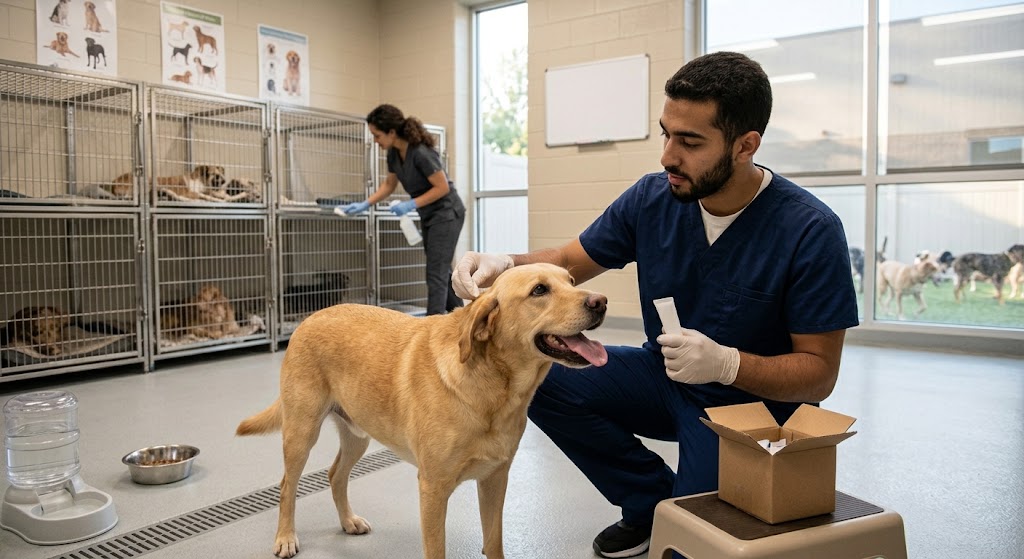
Understanding Parasite Transmission in Professional Dog Boarding
Boarding facilities create several conditions that can support parasite transmission if appropriate controls are absent.
Dogs may share exercise areas, interact during supervised play, occupy neighboring kennels, and use common walking routes. Even when direct contact is limited, parasites can spread through contaminated environments.
Transmission depends on the parasite involved.
Some parasites require direct contact between animals. Others spread through contaminated feces, soil, water, bedding, or intermediate hosts such as fleas. Certain parasites can also affect humans, making prevention a broader public-health concern.
The three main transmission pathways
Direct animal-to-animal exposure: Fleas, certain mites, and some other external parasites can spread through contact between infected and susceptible animals.
Environmental exposure: Intestinal parasite eggs, larvae, and protozoan cysts may contaminate outdoor areas, kennel floors, bedding, and other surfaces.
Intermediate-host transmission: Certain parasites require another organism to complete their life cycle. For example, dogs acquire the common flea tapeworm, Dipylidium caninum, by swallowing an infected flea.
These differences explain why a single universal parasite-control treatment cannot protect every dog against every parasite.
Professional Dog Boarding operators should identify the likely transmission route before selecting prevention and sanitation measures.
Flea Prevention: Managing Both the Animal and Its Environment
Fleas are among the most persistent external parasites encountered in dog boarding environments. Adult fleas live on animals and feed on blood, but much of their reproductive cycle takes place away from the host.
Female fleas lay eggs that fall into bedding, carpets, floor cracks, kennel corners, and outdoor resting areas. These eggs develop into larvae and eventually pupae before emerging as adult fleas.
This life cycle creates a significant management problem. A dog may receive an effective flea treatment while immature flea stages remain in the facility.
Recognizing an infestation
Common signs include:
- Repeated scratching and biting.
- Excessive licking or chewing.
- Flea dirt in the coat.
- Hair loss around the tail base.
- Red or irritated skin.
- Restlessness during sleep.
- Visible fleas moving through the fur.
Flea dirt consists of digested blood and may appear as tiny dark particles. When placed on a damp white surface, it can produce reddish-brown staining.
Some dogs develop flea allergy dermatitis, an allergic reaction to proteins in flea saliva. These animals may experience intense itching and skin inflammation even when only a small number of fleas are present.
Effective flea-control procedures
A professional Dog Boarding facility should inspect incoming dogs and ask owners about recent flea-prevention products.
However, visual inspection alone cannot guarantee that a dog is flea-free.
Facilities should coordinate veterinarian-recommended preventive treatments, clean bedding regularly, vacuum suitable indoor surfaces, and monitor areas where dogs spend considerable time.
Where an infestation is confirmed, treatment should address both affected animals and relevant environmental stages.
Facilities should avoid applying insecticides or environmental chemicals without checking product directions, animal safety requirements, and veterinary recommendations. Dogs should not be returned to treated areas until the product’s specified safety conditions have been met.
Tick Prevention: Reducing Exposure During Outdoor Activities
Ticks are blood-feeding external parasites that attach to dogs and may transmit infectious organisms.
Depending on the tick species and geographic region, diseases associated with tick exposure include ehrlichiosis, babesiosis, anaplasmosis, and Lyme disease.
Not every tick carries a pathogen, and not every tick bite results in illness. Nevertheless, the possibility of disease transmission makes routine inspection important.
Where ticks are encountered
Boarding dogs may encounter ticks in:
- Tall grass.
- Bushes and vegetation.
- Leaf litter.
- Woodland edges.
- Outdoor walking routes.
- Areas frequented by wildlife.
Ticks commonly wait on vegetation or move through the environment until they encounter a suitable host. They do not generally need to fall from trees to reach a dog.
Inspection and removal
Staff should examine dogs after outdoor activities, particularly those involving grassy or wooded environments.
Common attachment locations include the ears, neck, collar area, armpits, groin, and spaces between the toes.
Attached ticks should be removed using an appropriate tick-removal device or fine-tipped tweezers. The tool should grasp the tick close to the skin, and removal should be steady. Staff should avoid crushing the tick or applying petroleum jelly, oils, or other substances in an attempt to make it detach.
If removal is difficult or the skin becomes inflamed, veterinary assistance may be necessary.
Choosing appropriate tick prevention
Preventive products vary in their ability to repel or kill different tick species. Some work after the parasite attaches and begins feeding, while others provide repellent activity.
The correct option depends on the dog’s age, weight, health, geographic location, and veterinary advice.
Facilities should not assume that one product protects every dog against all tick-borne diseases.
Intestinal Worms: Detecting Infections That May Have No Visible Symptoms
Intestinal worms present a different challenge because infected dogs may appear healthy.
A dog can carry intestinal parasites without obvious weight loss, diarrhea, or changes in behavior. In a boarding environment, this creates the possibility of environmental contamination before the infection is recognized.
Four groups deserve particular attention.
Roundworms
* Toxocara canis* is an important canine roundworm. Dogs may become infected by swallowing infective eggs or through certain intermediate hosts. Puppies can also acquire infection from their mothers.
Possible signs include abdominal enlargement, poor growth, vomiting, diarrhea, and a dull coat. Some adult dogs show few symptoms.
Roundworm eggs can persist in contaminated soil for extended periods, making outdoor waste management particularly important.
Hookworms
Hookworms attach to the intestinal lining and feed on blood. Depending on the species, infection may occur through ingestion of infective larvae, skin penetration, or other routes.
In puppies and vulnerable dogs, hookworm infection can cause significant blood loss, anemia, weakness, and gastrointestinal problems.
Prompt feces removal is essential because eggs passed in stool can develop into infective larvae under suitable environmental conditions.
Whipworms
Whipworms live in the large intestine and can cause intermittent diarrhea, mucus in the stool, weight loss, and other digestive disturbances.
Their eggs may survive in the environment for long periods. Infection can also be difficult to detect because egg shedding is not always consistent.
A negative fecal test does not necessarily exclude whipworm infection when clinical suspicion remains high.
Tapeworms
Dogs commonly acquire Dipylidium caninum by swallowing infected fleas during grooming.
This demonstrates the relationship between external and internal parasite control.
Small, rice-like tapeworm segments may be visible around a dog’s rear end or in fresh feces. Veterinary examination can help confirm the infection and identify the appropriate treatment.
Fecal screening procedures
Veterinarians may use fecal flotation, antigen testing, or additional diagnostic methods to identify intestinal parasites.
The testing method depends on the suspected organism and the dog’s clinical history.
Facilities should encourage owners to maintain appropriate veterinary screening and deworming records. However, a single negative fecal examination should not be presented as proof that a dog cannot carry any intestinal parasite.
Giardia and Coccidia: Microscopic Parasites That Require Special Attention
Not all intestinal parasites are visible to the naked eye. Giardia and coccidia are microscopic organisms that can create significant sanitation challenges in Dog Boarding facilities.
Giardia
Giardia is an intestinal protozoan parasite transmitted through ingestion of infective cysts.
Dogs may encounter cysts in contaminated water, feces, food, or environmental surfaces.
Possible symptoms include:
- Intermittent diarrhea.
- Soft or unusually foul-smelling stools.
- Mucus in feces.
- Weight loss.
- Reduced appetite.
- Poor body condition.
Some infected dogs show no obvious symptoms.
Giardia cysts can survive in cool, moist environments, making damp kennel areas and contaminated water sources particularly relevant.
Veterinary diagnosis may involve fecal testing, antigen detection, or other laboratory methods. Because cyst shedding can vary, repeat testing may sometimes be recommended.
Coccidia
Coccidia are microscopic intestinal parasites that can be particularly problematic in puppies and crowded animal environments.
Dogs may develop diarrhea, dehydration, reduced appetite, and poor growth. The severity depends on the parasite species and the animal’s age and health.
The infectious stages develop in the environment after being passed in feces. This makes immediate waste removal and effective cleaning essential.
Why ordinary cleaning may not be enough
Giardia cysts and coccidia oocysts can be difficult to control when contaminated material remains in the environment.
Facilities must use cleaning procedures appropriate to the organism, following veterinary and product-specific recommendations.
Removing feces and organic material before applying an appropriate disinfectant or other control method is an important part of the process.
Mange Mites and Other External Parasites
Skin parasites can spread discomfort between animals and create difficult diagnostic situations because their symptoms often resemble allergies or bacterial skin infections.
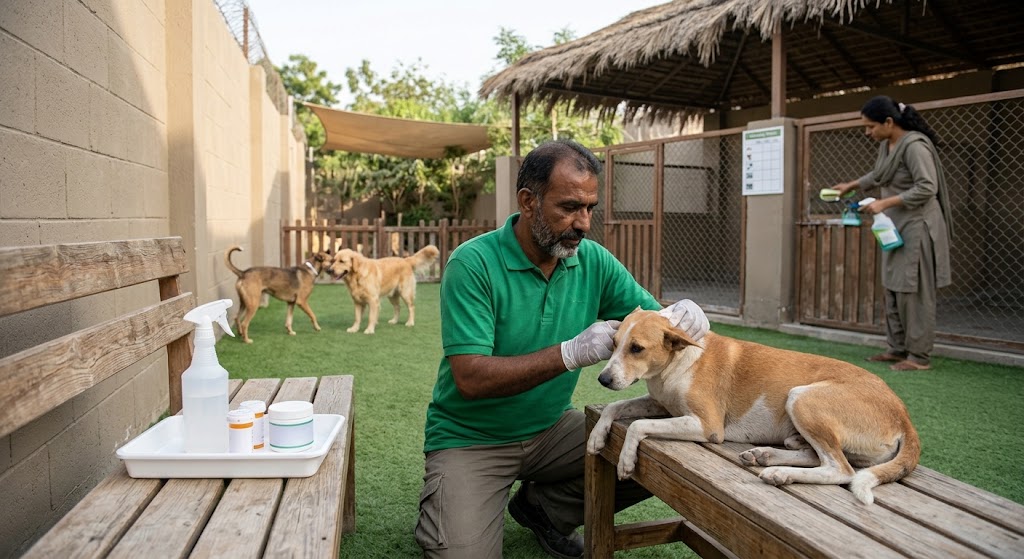
Sarcoptic mange
Sarcoptic mange is caused by Sarcoptes scabiei mites.
Affected dogs may develop severe itching, crusting, hair loss, and skin inflammation. Commonly affected areas include the ears, elbows, chest, and abdomen.
The condition is contagious between dogs and can also cause temporary skin irritation in people.
Dogs suspected of having sarcoptic mange should be separated from shared accommodation and referred for veterinary assessment.
Demodectic mange
Demodectic mange is associated with excessive populations of Demodex mites, which may normally exist in small numbers on healthy dogs.
Disease development is often associated with individual immune or health factors. Unlike sarcoptic mange, it is not generally considered contagious between adult dogs through ordinary contact.
This distinction is important because treating every case of skin irritation as a contagious infestation may lead to unnecessary isolation and inappropriate treatment.
Ear mites
Ear mites can cause head shaking, ear scratching, dark ear debris, and inflammation.
They are particularly relevant in puppies and animals with a history of close contact with other dogs.
Because bacterial and yeast ear infections can produce similar symptoms, diagnosis should be confirmed rather than based solely on visible discharge.
Arrival Screening: The First Line of Parasite Prevention
An effective Dog Boarding parasite-control program begins before a dog enters a shared sleeping or exercise area.
The admission process should include a consistent inspection and review of available veterinary information.
Physical screening
Trained staff should inspect:
- The coat for fleas and flea dirt.
- The skin for irritation, hair loss, or suspicious lesions.
- The ears for unusual debris.
- The body for attached ticks.
- The rear area for visible tapeworm segments.
- General condition and behavior.
- Stool quality when information is available.
Staff should also ask owners about recent parasite prevention, including the product used and its administration date.
Medical history
Useful information includes previous infestations, recent fecal examination results, prescribed treatments, known allergies, and any adverse reactions to parasite-control products.
The facility should distinguish between a documented treatment history and a confirmed current parasite-free status. They are not the same thing.
When admission should be delayed
A dog with unexplained severe itching, visible parasites, persistent diarrhea, or suspicious skin lesions may require veterinary assessment before joining other animals.
The facility should have clear admission policies explaining when separation, delayed admission, or veterinary clearance is necessary.
This protects existing boarding dogs while ensuring that the affected animal receives appropriate attention.
Environmental Sanitation: Controlling Parasites Beyond the Dog
Environmental management is essential because many parasites have life stages that survive outside the animal.
Cleaning and disinfection perform different functions.
Cleaning removes visible dirt, feces, hair, food particles, and organic material. Disinfection uses an appropriate product or method to reduce specific infectious organisms.
Not every disinfectant works against every parasite. For example, some parasite eggs and environmental stages are resistant to many routine chemical products.
Daily sanitation priorities
Professional facilities should establish written procedures covering:
- Immediate feces removal.
- Cleaning of kennel floors and surfaces.
- Regular washing of bedding.
- Cleaning of feeding and drinking bowls.
- Removal of accumulated hair and debris.
- Cleaning of shared handling equipment.
- Management of contaminated outdoor areas.
- Separate handling of items from affected dogs.
Surfaces should be cleaned before applying disinfectants because organic material can reduce product effectiveness.
Laundry management
Bedding, towels, and blankets can carry fleas, eggs, hair, and contaminated material.
Used laundry should be separated from clean supplies, handled carefully, and washed and dried according to appropriate hygiene procedures and fabric requirements.
Clean bedding should be stored in a separate area to avoid accidental contamination.
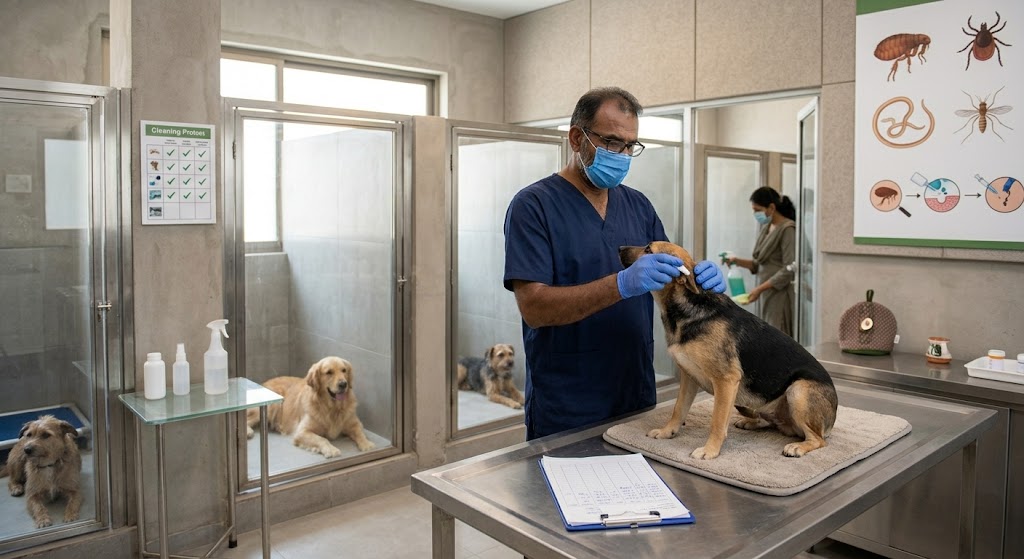
Outdoor environment management
Outdoor spaces require a different strategy from indoor kennels.
Facilities should remove feces promptly, manage tall vegetation where appropriate, prevent access to heavily contaminated soil, and reduce standing water.
Some parasite eggs may remain viable in soil for long periods. In such cases, ordinary spraying or surface cleaning cannot guarantee elimination.
Restricting access to contaminated areas and improving waste-management practices may be more effective.
Veterinary Treatment Coordination and Medication Safety
A facility should never assume that one parasite-control product is appropriate for every dog or every infestation.
Products differ in their active ingredients, target organisms, duration of protection, age restrictions, and potential interactions.
For example, a flea treatment may not control intestinal worms, while a routine deworming product may not treat Giardia or coccidia.
Information required before treatment
Before administering or recommending a parasite-control product, the facility should establish:
- The dog’s age and weight.
- The suspected or confirmed parasite.
- Existing medications.
- Relevant medical conditions.
- Previous adverse reactions.
- Whether the animal is pregnant or nursing.
- Veterinary instructions.
- Whether other animals require assessment.
Some products intended for dogs can be dangerous to cats or other species. Facilities that accommodate multiple animal types should pay particular attention to product storage and handling.
Coordinating treatment between owners and veterinarians
When an infestation is discovered, the owner should be informed promptly.
The veterinarian can determine whether diagnostic testing, medication, environmental treatment, or additional precautions are necessary.
If several dogs develop similar symptoms, management should consider a shared exposure rather than treating each incident as unrelated.
Facilities should document the treatment instructions received and ensure that the appropriate staff members understand their responsibilities.
Reinfection: Why a Treated Dog May Develop Another Infestation
One of the most frustrating problems in parasite control is recurrence.
An infestation may return because treatment addressed the adult parasite but not its environmental stages or because the dog encountered another infected animal or contaminated area.
Common causes of reinfection
- Untreated animal contacts.
- Contaminated bedding or kennel surfaces.
- Inadequate feces removal.
- Continued access to infected outdoor areas.
- Incomplete treatment.
- Incorrect product selection.
- Failure to follow veterinary instructions.
- Exposure to intermediate hosts such as infected fleas.
Fleas provide a useful example. Adult fleas may be eliminated from a dog while pupae remain in the surrounding environment. Newly emerged fleas can then attach to the animal again.
Intestinal parasite reinfection can follow a different route. Dogs may swallow infective eggs or larvae from contaminated soil, or ingest infected fleas carrying tapeworm stages.
The correct prevention method depends on understanding the parasite’s complete life cycle.
Facilities should investigate repeated cases instead of automatically repeating treatment without identifying the source.
Protecting Boarding Staff and Visitors From Zoonotic Parasites
Some parasites affecting dogs can also cause disease in people.
Roundworms and hookworms are important examples. Certain tick species also transmit infections to humans.
Exposure may occur through contaminated soil, feces, infected fleas, or direct contact with an affected animal.
Professional Dog Boarding facilities should provide staff with clear hygiene procedures.
These should include:
- Washing hands after handling dogs or cleaning kennels.
- Wearing suitable protective gloves during waste removal.
- Avoiding direct contact with suspicious skin lesions.
- Separating contaminated bedding.
- Cleaning fecal spills promptly.
- Storing parasite-control products safely.
- Following product-specific handling instructions.
Staff should also receive guidance about reporting possible occupational exposure and seeking medical advice when appropriate.
Staff Training and Documentation: Making Parasite Prevention Consistent
Even an excellent sanitation system can fail when employees do not understand their responsibilities.
A staff member may notice a dog scratching but assume it is a behavioral issue. Another may identify abnormal stool but fail to report it because the dog appears energetic.
Training should help employees recognize common warning signs and understand when veterinary assessment is necessary.
Essential training areas
Staff should understand:
- Common external and internal parasites.
- Typical signs of infestation.
- Basic transmission pathways.
- Safe handling of affected animals.
- Cleaning and laundry procedures.
- Correct reporting and escalation.
- The limitations of visual screening.
- Why treatments must follow veterinary instructions.
Maintaining accurate records
A facility should document arrival inspections, reported symptoms, cleaning activities, suspected infestations, veterinary instructions, and treatment-related observations.
These records help management identify repeated problems and establish whether an incident is isolated or part of a broader pattern.
They also support communication with owners and veterinary professionals.
A Practical Parasite-Control Schedule for Professional Dog Boarding
A structured schedule makes parasite prevention easier to maintain during busy operating periods.
| Stage | Recommended action |
|---|---|
| Before arrival | Review veterinary history and parasite-prevention records |
| At check-in | Inspect coat, skin, ears, and general condition |
| Before group activity | Confirm that no concerning signs require separation |
| During boarding | Monitor scratching, skin changes, and stool quality |
| Daily | Remove feces and clean contaminated surfaces |
| Regularly | Wash bedding and inspect outdoor areas |
| When symptoms appear | Separate when appropriate and notify management |
| After veterinary assessment | Follow the prescribed treatment and control plan |
| After an incident | Review possible exposure and reinfection sources |
The schedule should be adapted to the facility’s layout, local parasite risks, climate, and veterinary guidance.
Evaluating Whether the Parasite-Control Program Is Effective
A parasite-control program should be reviewed rather than treated as a permanent checklist that never changes.
Management should examine whether infestations are recurring, whether staff complete cleaning tasks, and whether dogs with suspected infections are handled according to policy.
Repeated flea problems may indicate environmental control gaps. Recurring intestinal infections may suggest contaminated soil or ineffective waste management. Multiple cases of skin irritation may justify investigation into contagious mites or other shared exposures.
Facilities should also review seasonal patterns. Fleas, ticks, and certain environmental parasites may become more relevant under particular local weather conditions.
The objective is not to promise that parasite exposure can never occur. No facility can guarantee that every dog is completely free from all parasites at all times. The objective is to reduce preventable exposure, identify problems early, and respond effectively.
Building a Reliable Parasite-Prevention Standard for Dog Boarding
Parasite prevention in professional Dog Boarding is a continuous responsibility involving individual medical care, environmental hygiene, veterinary coordination, and staff accountability.
Fleas require attention to their complete life cycle. Ticks require regular inspection and appropriate regional prevention. Intestinal worms demand fecal management and suitable diagnostic testing. Giardia and coccidia require careful control of contaminated environments, while mange mites and other external parasites may require isolation and targeted treatment.
The most effective facilities understand that eliminating visible parasites from one dog does not necessarily eliminate the risk throughout the premises.
A strong program looks beyond the immediate infestation. It identifies how the parasite entered the facility, where it may survive, which animals could have been exposed, and what changes will prevent another occurrence.
That approach creates a more dependable Dog Boarding environment, protects animal welfare, reduces avoidable treatment complications, and gives owners greater confidence that parasite risks are being managed through consistent, evidence-informed procedures.