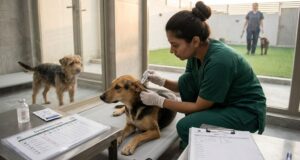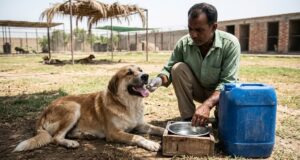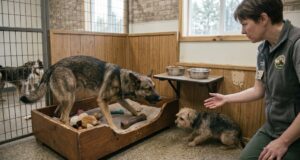
A dog that becomes uncomfortable around unfamiliar people may experience Dog Boarding very differently from a confident, socially relaxed dog. For some animals, the arrival of an unfamiliar staff member, an attempt to attach a leash, or a routine health check can create considerable emotional pressure. Even when a boarding facility provides clean accommodation, regular meals, exercise, and attentive supervision, interactions with unfamiliar humans may remain a significant source of stress.
The difficulty is not necessarily that the dog dislikes people or has received inadequate socialization. Fear can develop through previous negative experiences, limited exposure, genetic temperament, painful medical conditions, or repeated situations in which the animal feels unable to control an interaction. In a boarding environment, these factors become particularly relevant because dogs must depend on unfamiliar caregivers for feeding, cleaning, exercise, medication, and safety.
Understanding the relationship between human-directed fear and Dog Boarding requires more than recognizing growling or barking. Subtle body language, avoidance, freezing, defensive behavior, and the speed at which staff approach a dog can determine whether an unfamiliar environment becomes manageable or increasingly frightening.
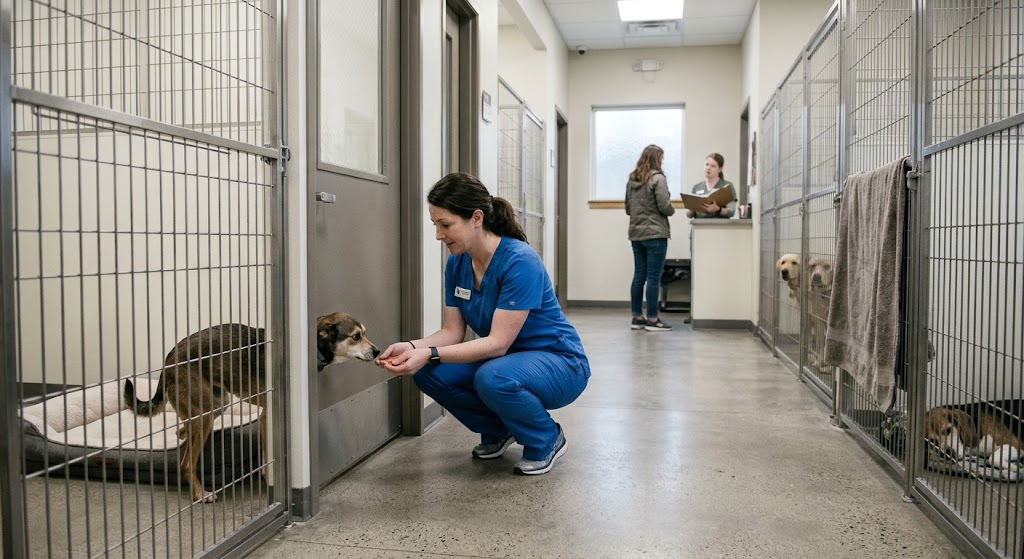
Understanding Why Some Dogs Fear Unfamiliar People During Dog Boarding
Fear of unfamiliar people is a behavioral response involving emotional, physiological, and learned components. A dog may interpret an unfamiliar person’s movement, voice, posture, smell, or proximity as potentially threatening.
Unlike humans, dogs cannot explain whether they are uncomfortable because someone is approaching too quickly, making direct eye contact, reaching over their head, or entering their personal space. Their behavior provides the primary information available to caregivers.
Genetic Temperament and Early Development
Individual differences in temperament influence how dogs respond to unfamiliar people. Some dogs naturally approach new individuals with curiosity, while others require considerably more time before accepting human contact.
Early experiences also matter. Puppies exposed to different people, environments, sounds, and handling experiences during appropriate developmental periods may become more comfortable with unfamiliar situations. However, exposure alone does not guarantee confidence. Experiences must be sufficiently positive and should not overwhelm the developing animal.
A puppy repeatedly forced to interact with frightening people may learn that unfamiliar humans are unpredictable. Conversely, a dog that receives limited exposure may simply lack the experience needed to interpret unfamiliar social situations comfortably.
Previous Negative Experiences and Learned Fear
A dog that has experienced rough handling, punishment, frightening veterinary procedures, or physical discomfort may associate certain human behaviors with danger.
For example, a dog previously restrained forcefully might become uncomfortable whenever an unfamiliar employee reaches toward its collar. The employee may have no intention of causing harm, but the dog’s learned association can trigger a defensive response.
This process involves classical conditioning. A previously neutral stimulus, such as a person’s hand approaching the dog’s head, becomes associated with an unpleasant experience. Eventually, the approaching hand itself may trigger anxiety.
During Dog Boarding, multiple unfamiliar employees can unintentionally activate these learned associations throughout the day.
Recognizing Canine Body Language Before Fear Escalates
One of the most important responsibilities of Dog Boarding staff is identifying discomfort before it develops into a defensive incident.
Dogs communicate through combinations of facial expression, posture, movement, ear position, tail carriage, and behavioral changes. No single signal should be interpreted in isolation. A lowered tail, for example, may reflect fear, uncertainty, physical discomfort, or an individual’s normal posture.
Subtle Early Warning Signals
Some dogs display relatively quiet signs of anxiety rather than obvious resistance. These signals may include:
- Turning the head away when someone approaches.
- Repeated lip licking without food being present.
- Yawning during social interaction.
- Showing the whites of the eyes, sometimes called whale eye.
- Lowering the head or body.
- Keeping the ears pulled backward.
- Moving behind furniture, bedding, or another object.
- Suddenly becoming unusually still.
- Refusing treats when an unfamiliar person is nearby.
- Repeatedly looking toward an exit or attempting to increase distance.
These behaviors do not automatically prove fear. Lip licking, yawning, and looking away can occur for other reasons. Their significance increases when several signals appear together or repeatedly occur during human interaction.
A dog that accepts food from familiar owners but refuses it when an unfamiliar boarding employee approaches may be communicating discomfort rather than simply being a picky eater.
Why Avoidance Should Be Taken Seriously
Avoidance is often a dog’s attempt to manage an uncomfortable situation without confrontation.
A dog may move away, hide in a kennel corner, retreat behind its bed, or turn its body away from a person. These actions are frequently misunderstood as stubbornness or poor social behavior.
In reality, avoidance can be an effective way for an animal to prevent a frightening interaction from escalating.
If staff repeatedly follow, corner, or reach for a dog that is trying to withdraw, the animal may learn that avoidance does not work. When escape becomes difficult, defensive behavior can become more likely.
Professional Dog Boarding facilities should therefore treat withdrawal as meaningful communication, not as an inconvenience that must immediately be corrected.
Freezing: The Overlooked Fear Response in Boarding Kennels
Freezing deserves particular attention because it is easily mistaken for cooperation.
A fearful dog may stop moving, hold its body rigid, lower its head, avoid eye contact, or remain motionless while an unfamiliar person approaches. Staff may interpret this behavior as calm acceptance because the animal is not barking, pulling away, or growling.
However, freezing can represent a high level of emotional discomfort.
Why Dogs Become Motionless
Freezing is one of several defensive responses animals may display when confronted with a perceived threat. Depending on the circumstances, a dog may attempt to escape, remain motionless, defend itself, or use a combination of responses.
A dog that feels unable to escape may become extremely still while monitoring the unfamiliar person. This does not necessarily mean the dog has accepted the interaction.
For example, consider a dog that remains motionless when an employee bends over to attach a leash. Its body is stiff, its mouth is tightly closed, and its eyes follow the employee’s movements. Although the leash is attached successfully, the dog may be experiencing substantial fear.
If the same handling continues repeatedly, the dog may eventually progress from freezing to growling or snapping.
Why Forced Handling Can Make Freezing Worse
When staff assume that a motionless dog is comfortable, they may continue touching, lifting, restraining, or repositioning it.
This creates a serious welfare concern because the dog has little opportunity to communicate discomfort successfully.
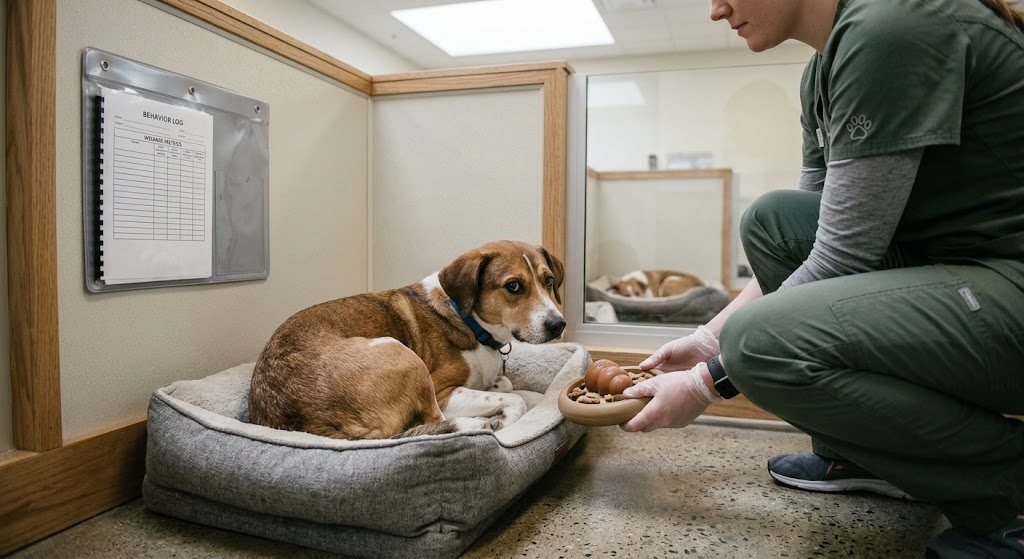
A low-stress approach involves observing the animal’s posture, reducing physical pressure, and allowing time for voluntary movement. Staff should avoid interpreting the absence of resistance as consent.
Where handling is medically necessary, the facility should coordinate with the owner and veterinarian to establish an appropriate plan rather than relying on increasingly forceful restraint.
Defensive Reactions: When Fear Becomes a Safety Concern
Fear-related defensive behavior is not necessarily evidence of a naturally aggressive dog. In many situations, it reflects an animal’s attempt to increase distance from something it perceives as threatening.
During Dog Boarding, defensive responses may develop when staff ignore early warning signals or repeatedly approach a dog that is already uncomfortable.
Growling, Snapping, and Biting
A fearful dog may initially communicate discomfort through avoidance, lowered posture, facial tension, or freezing. If the interaction continues, more obvious behaviors may follow.
These can include:
- Growling when someone approaches the kennel.
- Barking when an employee attempts to attach a leash.
- Showing teeth during physical handling.
- Lunging when someone reaches into the dog’s resting area.
- Snapping when restrained.
- Biting when escape appears impossible.
Growling is particularly valuable information. It provides a warning that the dog wants the interaction to stop or the distance to increase.
Punishing growling is counterproductive because it may suppress an important warning signal without changing the underlying fear. A dog that learns not to growl may still feel threatened and could move to a more immediate defensive response.
Staff should respond by stopping the interaction when safe, creating distance, and reassessing the handling plan.
Identifying Triggers Instead of Labeling the Dog
A useful behavioral assessment asks what happened immediately before the defensive response.
Potential triggers include:
- Direct eye contact.
- Leaning over the dog’s body.
- Reaching toward the collar.
- Entering the kennel while the dog is resting.
- Moving too quickly.
- Attempting to remove food or toys.
- Touching painful areas.
- Repeatedly approaching without allowing withdrawal.
- Several unfamiliar people interacting with the dog in quick succession.
Recording these circumstances helps staff distinguish between a generalized fear of unfamiliar people and specific handling-related triggers.
This distinction is important because different triggers require different management strategies.
Gradual Introductions: Building Trust Without Forcing Interaction
Gradual introductions are among the most useful strategies for helping fearful dogs adjust to Dog Boarding. The objective is not to make the animal interact with every employee. It is to create predictable, manageable experiences that allow the dog to feel safer around the people responsible for its care.
Start With Distance and Observation
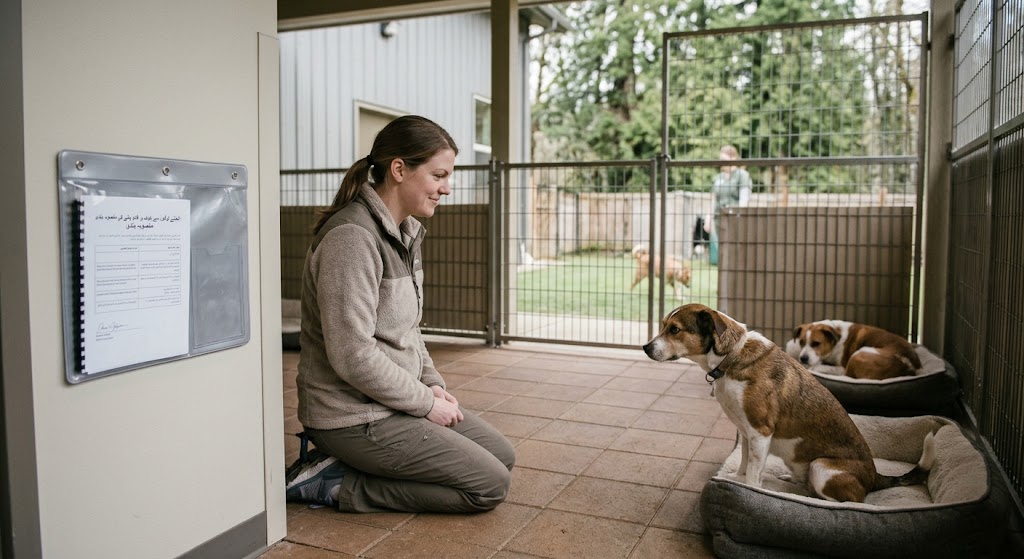
The first interaction should generally occur at a distance where the dog can notice the unfamiliar person without showing significant distress.
The employee should avoid approaching directly, leaning over the dog, or attempting immediate physical contact.
A better approach may involve sitting or standing sideways, keeping movements controlled, and allowing the dog to observe.
If the dog chooses to approach voluntarily, the employee should not immediately reach out to touch it. Allowing the animal to investigate without pressure can help establish a more positive first experience.
Use Desensitization and Counterconditioning
Two established behavioral techniques can help change fearful associations.
Desensitization involves introducing a trigger gradually at an intensity the dog can tolerate. For example, an unfamiliar employee might initially remain several feet away before gradually becoming more familiar with the dog’s presence over multiple sessions.
Counterconditioning involves pairing the previously frightening stimulus with something the dog finds rewarding. An employee might gently toss a suitable treat away from their body whenever they appear at a comfortable distance.
The dog begins to associate the person’s presence with a positive outcome.
These techniques must be adjusted to the individual animal. If the dog becomes tense, stops accepting food, retreats, or displays other signs of increasing anxiety, the interaction may be too difficult.
Food should never be used to lure a frightened dog into a position where it suddenly finds itself within touching distance of a person it fears.
Progress at the Dog’s Pace
Behavioral progress is not always linear. A dog may accept one employee but remain frightened of another. It may become more comfortable in a quiet room but react defensively in a busy kennel corridor.
Staff should recognize that familiarity with one person does not automatically transfer to everyone.
For some dogs, successful progress means accepting necessary care without panic. For others, it may mean voluntarily approaching a familiar caregiver. Physical affection should not be treated as the required measure of success.
Low-Stress Handling Practices in Professional Dog Boarding
Even a well-designed introduction program can fail if routine handling repeatedly overwhelms the dog.
Low-stress handling aims to reduce unnecessary physical pressure, improve predictability, and preserve the animal’s sense of control wherever practical.
Use Consistent Caregivers
Where staffing allows, assigning one or two familiar caregivers can reduce the number of unfamiliar interactions.
Consistency helps staff learn the dog’s individual signals, preferred distance, food preferences, and handling sensitivities.
It also prevents conflicting approaches. One employee may understand that a dog needs space, while another may unintentionally approach too quickly.
A written behavioral profile should communicate the dog’s needs across shifts.
Avoid Direct Confrontation
People sometimes approach unfamiliar dogs by facing them directly, looking into their eyes, bending forward, and extending a hand. Although these actions may seem friendly to humans, they can feel threatening to some fearful dogs.
A less intrusive approach includes:
- Standing at an angle rather than directly facing the dog.
- Avoiding prolonged direct eye contact.
- Keeping hands away from the dog’s face.
- Moving slowly and predictably.
- Allowing the dog to maintain a comfortable distance.
- Avoiding unnecessary touching.
- Giving the dog a clear route to retreat.
Staff should also avoid surrounding a fearful dog with several people. Multiple approaching bodies can make the animal feel trapped.
Preserve Predictable Daily Routines
Fearful dogs often benefit from consistent feeding, cleaning, walking, and resting schedules.
Unexpected changes can increase uncertainty. A dog that knows when its caregiver usually arrives may become more comfortable with that predictable routine.
Kennel placement also matters. A fearful dog may cope better in a quieter area away from busy entrances, frequent visitors, barking dogs, and constant staff movement.
Resting areas should provide privacy without compromising supervision or ventilation.
Medical Conditions That Can Increase Fear of Unfamiliar People
Not every fearful response is purely behavioral. Pain and illness can significantly influence how dogs tolerate human contact.
A dog with arthritis may become defensive when someone reaches toward its hips. Dental disease can make facial handling uncomfortable. Ear infections may cause a dog to react when an employee attempts to examine its head.
Other possible contributors include:
- Musculoskeletal injuries.
- Skin irritation or painful wounds.
- Gastrointestinal discomfort.
- Vision or hearing impairment.
- Neurological disorders.
- Age-related cognitive changes.
- Previous traumatic medical experiences.
A sudden change in tolerance should prompt consideration of medical causes.
For example, a previously friendly dog that begins growling when its collar is touched may be experiencing neck pain rather than developing a generalized fear of people.
Boarding operators should not attempt to diagnose these conditions themselves. They should document the behavior, inform the owner, and recommend veterinary assessment when appropriate.
How Fear of Unfamiliar People Affects Boarding Operations
Human-directed fear influences more than the dog’s emotional comfort. It can affect daily care, staff safety, cleaning procedures, emergency response, and the facility’s ability to provide reliable supervision.
Feeding, Medication, and Routine Care
A fearful dog may refuse food when an employee approaches. It may also resist medication administration, grooming, leash attachment, or routine health checks.
These difficulties can become particularly serious when the dog requires medication for a chronic condition.
Facilities should obtain detailed instructions before accepting dogs with known handling sensitivities. If medication requires physical administration that cannot be performed safely, the operator must discuss alternative arrangements with the owner and veterinarian.
Staff Training and Workplace Safety
Employees need training in canine body language, fear recognition, safe positioning, and appropriate responses to defensive behavior.
A staff member should know when to stop an interaction rather than attempting to prove that they can control the dog.
Facilities should also maintain incident records. Documentation should identify the trigger, observable behavior, environmental conditions, staff response, and outcome.
This information can help management identify repeated handling mistakes and improve staff procedures.
When a Boarding Facility May Not Be Suitable
Some dogs experience such intense fear that a conventional boarding kennel cannot meet their needs safely or humanely.
This may include dogs that panic around unfamiliar caregivers, repeatedly attempt to escape, cannot tolerate necessary handling, or display serious defensive reactions despite reasonable management.
In these situations, alternatives may include an experienced in-home pet sitter, a familiar caregiver, veterinary-supervised boarding, or a specialized behavior-focused facility.
Choosing an alternative is not a failure. The appropriate care arrangement is the one that can meet the dog’s medical, behavioral, and safety needs.
Preparing Fearful Dogs Before Dog Boarding
Owners can reduce uncertainty by providing the facility with accurate behavioral information before the first stay.
A useful preparation plan includes:
- Disclose known fears: Explain which types of people, movements, or handling situations make the dog uncomfortable.
- Provide medical information: Share relevant diagnoses, medication instructions, pain history, and veterinary contact details.
- Arrange a preliminary visit: If appropriate, allow the dog to investigate the facility without immediately requiring a full boarding stay.
- Introduce caregivers gradually: Short, low-pressure meetings may help the dog become familiar with one or two employees.
- Discuss handling boundaries: Explain whether the dog dislikes collar handling, head touching, restraint, or direct approaches.
- Provide familiar items: A familiar blanket or bedding item may offer environmental familiarity, provided the facility permits it and it can be used safely.
- Consider a short trial stay: A brief stay may help assess whether the facility can meet the dog’s needs before a longer booking.
A trial stay should not be treated as an obligation or a test the dog must pass. If the experience produces significant distress, the owner and facility should reconsider the arrangement.
Comfort Is More Important Than Social Interaction
One of the most common misunderstandings in dog care is assuming that successful adjustment means a dog becomes friendly with everyone.
For a dog with a history of fear, a realistic outcome may involve remaining relaxed while a familiar employee cleans the kennel, accepting meals without hiding, or walking calmly with one trusted caregiver.
Progress should be assessed through observable changes, including:
- Reduced avoidance during necessary care.
- Less frequent freezing and body tension.
- Improved appetite in the presence of familiar staff.
- Greater willingness to rest.
- More predictable responses to routine handling.
- Fewer defensive reactions.
- Faster recovery after unavoidable stressful events.
Staff should also consider the dog’s behavior between interactions. An animal that tolerates handling but remains withdrawn, restless, or unable to sleep may still be experiencing significant stress.
Behavioral observations are more meaningful when compared with the dog’s normal behavior at home.
A More Humane Approach to Dog Boarding for Fearful Dogs
Dog Boarding should not require every dog to become socially confident or comfortable with unfamiliar people. Some animals need more distance, slower introductions, consistent caregivers, and carefully managed routines than others.
The central principle is to recognize fear as communication rather than disobedience. Avoidance, freezing, facial tension, and defensive reactions provide information about how a dog experiences its environment. Ignoring those signals can increase distress and create preventable safety problems.
A responsible facility does not measure success by how quickly a fearful dog accepts physical contact. It measures success by whether the animal can receive necessary care while maintaining reasonable emotional comfort and physical safety.
When owners and boarding professionals work together, gradual behavioral conditioning, medical awareness, predictable handling, and individualized care can make some boarding experiences considerably more manageable. For dogs whose fear remains severe, choosing a different care arrangement may be the most compassionate decision.