A dog that peacefully shares its home with another pet may behave very differently when placed in a shared Dog Boarding environment. At home, familiar routines, established relationships, and predictable access to food, resting areas, and people can make everyday interactions relatively comfortable. In a boarding facility, however, unfamiliar dogs, changing social arrangements, limited personal space, and competition for attention can create situations in which guarding behavior becomes more noticeable.
Resource guarding is often misunderstood as simple possessiveness or deliberate aggression. In canine behavior, it is better understood as a response in which a dog uses body language, positioning, threats, or physical actions to maintain control over something it considers valuable. That resource might be a food bowl, a chew toy, a comfortable sleeping area, or even access to a particular caregiver.
For professional Dog Boarding operators, recognizing resource guarding early is essential. A dog that stiffens when another animal approaches its food may not initially appear dangerous. However, if the warning is ignored or the environment repeatedly places dogs in competitive situations, the behavior can escalate into a fight. Effective management requires understanding the underlying motivation, identifying early signals, controlling access to valuable resources, and designing a boarding environment that does not force unnecessary competition.
A Behavioral Case Study: How Resource Guarding Develops in Shared Boarding Spaces
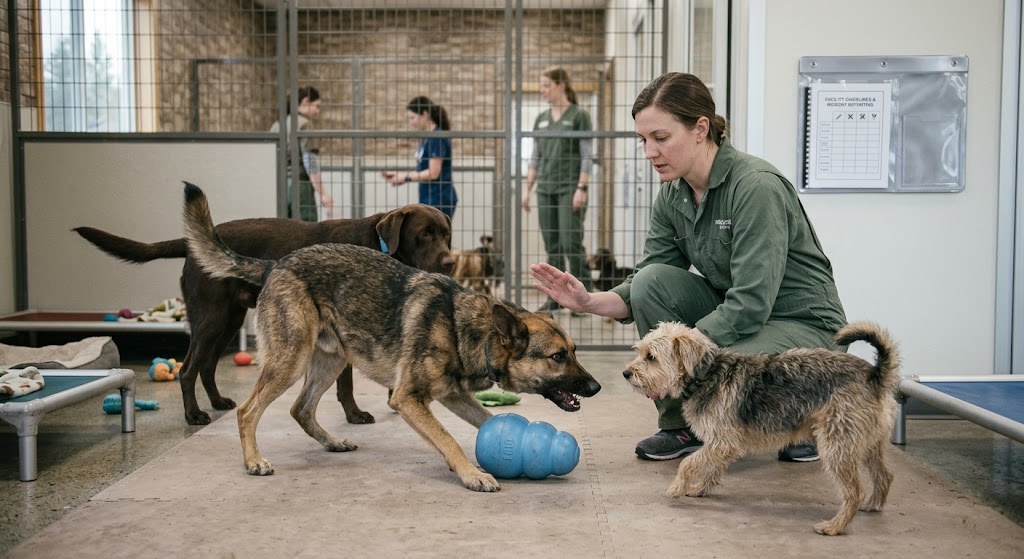
Consider a hypothetical boarding situation involving two dogs sharing a supervised activity area. One dog, accustomed to eating alone at home, receives a food puzzle while the other dog explores nearby. Initially, both animals appear relaxed. When the second dog approaches the puzzle, however, the first dog lowers its head, stops chewing, and positions its body between the approaching animal and the food.
The second dog moves closer. The first dog becomes rigid and gives a low growl. Staff intervene by increasing distance, but the incident reveals an important management issue: the dogs were placed in a situation where access to a valuable resource was not adequately controlled.
This example illustrates how resource guarding can emerge even when a dog has no previous history of fighting.
Why a Boarding Environment Can Change the Situation
Resource guarding is influenced by several interacting factors:
- The perceived value of the resource.
- Previous experiences involving competition or loss.
- The dog’s temperament and emotional state.
- The presence and behavior of other animals.
- Environmental stress and unfamiliar surroundings.
- The dog’s ability to retreat or maintain distance.
A dog experiencing uncertainty during Dog Boarding may become more sensitive to the availability of food, resting spaces, toys, or human attention.
This does not mean that every stressed dog will guard resources. Nor does it mean that a dog displaying guarding behavior is necessarily unsuitable for boarding. The important question is whether the facility can identify the behavior and manage the environment safely.
Food Guarding: The Most Recognizable Resource-Protection Behavior
Food is a particularly valuable resource for many dogs. Guarding may occur around ordinary meals, treats, bones, food puzzles, or even dropped pieces of food.
Common Food-Guarding Triggers
A dog may become protective when another animal approaches its bowl, moves toward a treat, or enters the feeding area while it is eating.
The behavior can also occur when a caregiver reaches toward the bowl or attempts to remove unfinished food.
Some dogs guard only highly desirable items, such as meat-based treats or long-lasting chews. Others show concern around ordinary meals.
A dog that eats comfortably in a private kennel may become defensive when fed in a shared area. This difference highlights why feeding arrangements should be assessed individually rather than assuming that a dog’s behavior will remain consistent across environments.
Early Warning Signals Around Food
Food guarding may begin with subtle changes rather than immediate growling.
Staff should watch for:
- Eating unusually quickly when another dog approaches.
- Lowering the head over the food.
- Positioning the body between another animal and the bowl.
- Becoming suddenly still while eating.
- Staring at an approaching dog.
- Showing facial tension.
- Pausing chewing to monitor nearby movement.
- Growling or showing teeth when approached.
Not every dog that eats quickly is guarding food. However, sudden changes in eating behavior, especially when another animal approaches, deserve attention.
Professional Feeding Management
The safest approach in most boarding environments is to feed dogs separately.
Each dog should have a designated feeding space where other animals cannot approach. Staff should avoid placing bowls close together simply because the dogs appear friendly during play.
Food bowls should be removed after feeding when it is safe to do so. Staff should also inspect shared areas for dropped food, treats, and leftover edible items that could become unexpected sources of conflict.
Dogs with a known history of food guarding should not be expected to share feeding equipment or compete for treats.
Toy Guarding: When Play Objects Become Valuable Possessions
Toys can create a different type of resource conflict. Some dogs enjoy sharing play objects, while others become protective when another animal approaches a favorite ball, rope, squeaky toy, or chew item.
Why Toy Conflicts Develop
The value of a toy depends on the individual dog. A common tennis ball may be unimportant to one animal but extremely desirable to another.
Competition can become more complicated when several dogs are excited, moving quickly, and attempting to access the same object.
For example, a dog carrying a ball may initially tolerate another dog approaching. However, if the second dog repeatedly tries to take the ball, the first dog may begin guarding it.
Some dogs also guard toys they are not actively using. They may leave an object on the ground but react when another animal approaches it.
Recognizing Toy-Related Warning Signs
Staff should look for:
- Carrying toys away from other dogs.
- Standing over an object.
- Holding a toy tightly while watching nearby animals.
- Becoming stiff when another dog approaches.
- Blocking access with the body.
- Growling when another dog attempts to take the object.
- Chasing or confronting another dog that picks it up.
A dog that retrieves toys enthusiastically is not necessarily guarding them. The important distinction is whether its behavior changes when another animal attempts to access the object.
Preventing Toy-Related Conflicts
Shared Dog Boarding play areas should not automatically contain every type of toy.
Facilities can reduce risk by removing highly desirable objects from group environments, providing individual enrichment sessions, and monitoring dogs that have previously shown guarding behavior.
If toys are used during supervised activities, staff should consider the temperament and interaction history of every dog involved.
When guarding is known or suspected, individual play is generally safer than attempting to teach unfamiliar dogs to share valuable objects during a boarding stay.
Sleeping-Space Guarding: Protecting Comfort and Personal Territory
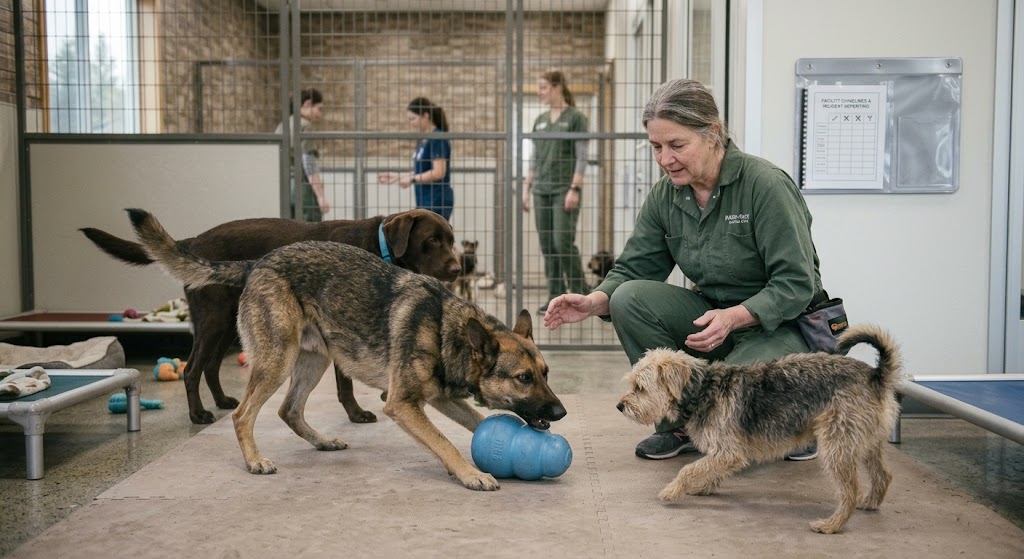
Sleeping areas are another important resource. A dog may become defensive when another animal approaches its bed, kennel, blanket, or preferred resting corner.
This behavior is sometimes overlooked because staff may interpret it as territorial aggression rather than recognizing the importance of rest and personal space.
Why Resting Dogs May Become Defensive
Dogs need opportunities to rest without interruption. A boarding facility can make this difficult if animals share limited space or are repeatedly exposed to movement and noise.
A sleeping dog may be startled when another animal approaches. A dog with joint pain or age-related discomfort may be especially sensitive to being disturbed.
For some animals, a particular bed or enclosed resting area becomes a source of security in an unfamiliar environment.
When another dog enters that space, the resting animal may react defensively.
Warning Signs Around Beds and Kennels
Possible signs include:
- Positioning the body across a bed entrance.
- Stiffening when another dog approaches.
- Lifting the head suddenly from a resting position.
- Giving a fixed stare.
- Growling when disturbed.
- Blocking access to bedding.
- Snapping when another animal enters the resting area.
Staff should avoid allowing dogs to crowd one another around kennel entrances, beds, or resting corners.
Designing Safer Resting Arrangements
Every dog should have a designated resting area that other animals cannot freely occupy.
Facilities should provide sufficient space, appropriate bedding, and physical separation where needed. Dogs that guard sleeping spaces should have individual accommodation rather than being expected to tolerate other animals entering their resting area.
Staff should also avoid waking dogs unnecessarily or allowing children and visitors to disturb resting animals.
Guarding Human Attention: When Caregivers Become a Valuable Resource
Resource guarding is not limited to objects. Some dogs become protective of access to a particular person.
During Dog Boarding, this may occur when one dog repeatedly seeks attention from a preferred caregiver and reacts when another dog approaches.
How Human-Attention Guarding Appears
A dog may:
- Push between a caregiver and another dog.
- Place its body against the employee.
- Block another animal from approaching.
- Stiffen when the caregiver touches another dog.
- Growl when another animal receives attention.
- Attempt to interrupt interactions by barking or physically moving forward.
This behavior can be difficult to manage because staff naturally need to interact with multiple animals.
A dog that guards human attention may also become frustrated when its preferred caregiver leaves.
Why Staff Should Avoid Reinforcing Competition
Caregivers should avoid allowing several dogs to compete physically for attention in crowded spaces.
If a dog consistently pushes another animal away and immediately receives exclusive attention, the interaction may unintentionally reinforce that strategy.
A better arrangement involves giving dogs individual attention in controlled settings while preventing direct competition.
Staff should also avoid physically pushing dogs away from one another when guarding is suspected. Such interventions can increase tension or create a bite risk.
Human attention should be provided predictably rather than becoming an uncontrolled competition in shared areas.
Understanding the Emotional Triggers Behind Resource Guarding
Resource guarding is not a single, uniform behavior. Different dogs may guard the same object for different reasons.
Fear of Losing Something Valuable
One common explanation involves the expectation that another animal or person may take a valued resource away.
A dog that has experienced repeated competition may become more protective because it expects access to the resource to be interrupted.
This does not require a history of abuse or neglect. Ordinary experiences can influence how an individual dog responds to competition.
Stress and Environmental Uncertainty
A new boarding environment introduces unfamiliar sounds, smells, routines, and social interactions.
A dog may have fewer predictable opportunities to control its surroundings. Guarding can become one way of maintaining access to something that provides comfort or security.
However, stress should not be treated as the sole explanation. Genetic temperament, learning history, medical discomfort, and individual preferences can also contribute.
Pain and Medical Conditions
Pain can lower a dog’s tolerance for approaching people or animals.
A dog with arthritis may guard its bed because moving away is uncomfortable. A dog with dental pain may react when someone approaches its food. Skin conditions or injuries can make physical contact unpleasant.
If guarding develops suddenly or becomes noticeably worse, a veterinary examination is appropriate.
Safe Separation: The First Priority After Guarding Is Identified
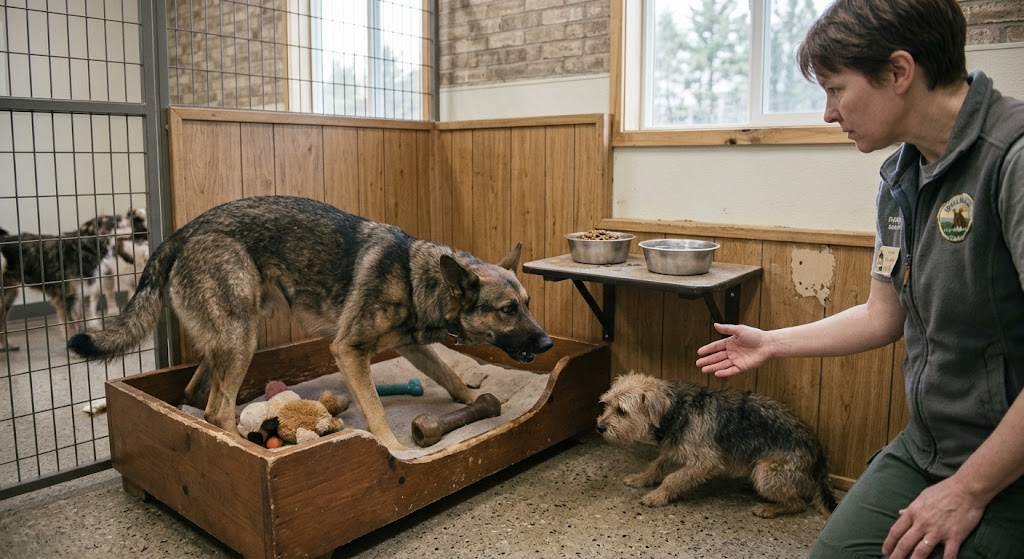
When a dog displays resource guarding, the immediate objective should be to prevent a confrontation rather than test whether the animal will tolerate another approach.
Avoid Directly Removing the Guarded Resource
Staff should not attempt to take food, toys, or bedding directly from a dog displaying threatening behavior unless an immediate safety emergency requires intervention.
Grabbing a bowl, reaching toward the dog’s mouth, or pulling an object away can increase the risk of a bite.
Punishing growling or physically confronting the dog is also inappropriate. These actions may increase fear and suppress warning signals without resolving the underlying motivation.
Use Environmental Separation
Safer management may include:
- Moving other dogs away from the area.
- Using secure barriers or separate kennel spaces.
- Feeding dogs individually.
- Removing shared toys from group environments.
- Providing individual resting areas.
- Preventing access to another dog’s food or belongings.
- Maintaining controlled movement through shared corridors.
Staff should use barriers and established facility procedures rather than placing their hands between fighting dogs.
If a fight occurs, employees should follow a trained emergency response protocol and obtain veterinary assessment for injured animals. Even apparently minor puncture wounds may require professional attention.
Professional Behavior Management During Dog Boarding
Effective management begins before the dog enters a shared environment.
Pre-Boarding Behavioral Assessment
Owners should be asked about previous guarding incidents involving:
- Food and treats.
- Bones and chew toys.
- Beds and sleeping spaces.
- Favorite people.
- Other household animals.
- Handling and removal of possessions.
Questions should focus on observable behavior rather than asking only whether the dog is aggressive.
For example, asking whether the dog stiffens when another animal approaches its food may produce more useful information than asking whether it is friendly.
A facility should also review bite history, medical conditions, medication requirements, and the dog’s experience with group environments.
Individualized Care Plans
Dogs with known guarding behavior should have written management plans.
These plans should identify the resources involved, known triggers, early warning signals, required separation arrangements, and safe handling procedures.
Staff across all shifts should receive the same information. A dog that is safely managed during the morning shift may encounter preventable risks if evening employees are unaware of its behavioral history.
When Professional Behavioral Support Is Necessary
Repeated guarding, escalating threats, biting incidents, or guarding across multiple types of resources may require assessment by a qualified veterinary behaviorist or appropriately credentialed canine behavior professional.
Behavior modification may involve carefully designed desensitization and counterconditioning. These approaches should be individualized and conducted at a level the dog can tolerate.
Owners should not expect a boarding facility to resolve a serious behavioral problem during a short stay. The primary responsibility of the boarding operator is safe, humane management.
How Owners Can Prepare Dogs for Resource-Safe Boarding
Owners can help facilities make better decisions by providing honest information and discussing management needs before arrival.
Useful steps include:
- Explain any previous food, toy, bed, or attention-related guarding.
- Describe the specific situations that trigger the behavior.
- Inform staff whether the dog has ever snapped or bitten.
- Provide medical information that could affect handling or movement.
- Ask how feeding and enrichment activities are managed.
- Confirm that individual resting spaces are available.
- Discuss whether group play is appropriate or whether individual activities are safer.
Owners should never hide a guarding history out of concern that the facility may refuse the booking. Accurate information allows operators to assess whether they can provide suitable care.
Evaluating Success: Prevention Is More Important Than Forced Sharing
A successful Dog Boarding arrangement does not require dogs to share every resource peacefully.
Some dogs are more comfortable eating alone, sleeping in private spaces, and enjoying toys without other animals nearby. These preferences are not necessarily behavioral failures.
A well-managed facility measures success through the absence of preventable conflicts, reliable access to food and rest, appropriate enrichment, and the dog’s ability to receive care without excessive stress.
Staff should also review incidents and near misses. A growl that results in safe separation provides useful information about the environment and the dog’s needs. It should lead to improved management rather than punishment.
Building Safer Shared Spaces Through Individualized Dog Boarding
Resource guarding reveals an important limitation of assuming that friendly dogs can safely share every part of a boarding environment. Social compatibility does not automatically mean compatibility around food, toys, sleeping areas, or human attention.
The most responsible approach to Dog Boarding is to recognize that resources have different values for different dogs. Facilities should organize feeding, enrichment, resting, and caregiver interactions around individual behavioral needs rather than expecting animals to compete or negotiate access.
Early warning signals deserve attention, physical separation should be used when necessary, and staff should never treat forced sharing as a measure of good social behavior.
When professional management prioritizes predictable routines, private resources, informed supervision, and appropriate behavioral support, boarding facilities can reduce conflict while protecting the emotional and physical welfare of every dog in their care.